Sunday, November 14, 2010

Danionella dracula


One of the evolutionary peculiarities of my favorite lab animal, the zebrafish, and of cypriniform fishes in general, is that they lack teeth. They lost them over 50 million years ago, and don't even form a dental lamina in development. So this photo of a cypriniform, Danionella dracula, gave me a bit of a start beyond just the nice fangs and the ghoulish name.
The story doesn't give much detail, but I'm going to have to look into this. Those are not true teeth, but spiny outgrowths of bone directly from the jaws.

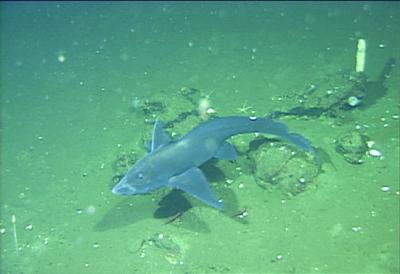
Ghostshark (hydrolagus melanophasma)


A new ghostshark species has been identified off the coast of Southern California, and
it’s darker and weirder than any shark we know.

The purplish black ancient relative of the modern shark comes packed with a suite of odd features that give its taxonomical family the name chimaera, after the mythical beast made from the parts of many animals.


“It’s a big weird looking freaky thing,” said ichthyologist Doug Long of the California Academy of Sciences. “They have some shark characteristics and they have some that are very non-shark.”

Perhaps the most intriguing feature of the newly described species, Hydrolagus melanophasma, is a presumed sexual organ that extends from its forehead called a tentaculum.

“They have this club on the top of their head with spikes. People think it’s used for mating,” Long said. “It’s like a little mace with little spikes and hooks and it fits into their forehead. It’s jointed and it comes out. We’re not sure if it is used to stimulate the female or hold the female closer.”

Monday, August 16, 2010

Fish That Can Live on Land

Australia has long battled with all sorts of harmful, invasive species--and wildlife authorities are concerned that they may soon be facing a new threat from what may be one of meanest-looking of unwelcome guests. The culprit is a particularly troublesome creature called the Snakehead fish, which is able to breath air, allowing it to travel on land to find prey or migrate. Also known by the perhaps more fitting moniker "Fishzilla," the invasive fish has been discovered in parts of Oceania, and it may be only a matter of time until it makes its way to the Australian mainland.

According to a report in The Cairns Post, Snakehead fish have already been discovered on the southern coast of the neighboring island to the north, Papua New Guinea. The fish can grow up to three feet in length and are known to eat water birds, snakes and rodents. Snakehead fish are able to venture out of the water in search of prey which it devours whole.

Monday, March 2, 2009

Indonesia's psychedelic fish named a new species

A funky, psychedelic fish that bounces on the ocean floor like a rubber ball has been classified as a new species, a scientific journal reported. The frogfish - which has a swirl of tan and peach zebra stripes that extend from its aqua eyes to its tail - was initially discovered by scuba diving instructors working for a tour operator a year ago in shallow waters off Ambon island in eastern Indonesia.
The operator contacted Ted Pietsch, lead author of a paper published in this month's edition of Copeia, the journal of the American Society of Ichthyologists and Herpetologists, who submitted DNA work identifying it as a new species.
The fish - which the University of Washington professor has named "psychedelica" - is a member of the antennariid genus, Histiophryne, and like other frogfish, has fins on both sides of its body that have evolved to be leg-like.
But it has several behavioral traits not previously known to the others, Pietsch wrote.
Each time the fish strike the seabed, for instance, they push off with their fins and expel water from tiny gill openings to jet themselves forward. That, and an off-centered tail, causes them to bounce around in a bizarre, chaotic manner.

Friday, January 16, 2009

Jellyfish

The transparency of the jellyfish teaches the inner source within each of us. We have an enormous amount of power within us to draw upon. We can turn on the light even in the depths of darkness through the wisdom the jellyfish. It often shows up just when you believe there is no hope left.

The jellyfish sting symbolizes that even the most vulnerable has the ability to shield and protect itself from outside influences. The jellyfish is an electrifying totem. It offers a spark to energize and illuminate. Powerful!

source:http://healing.about.com

Quote of the day